


WeatherPlus Projects
What helped the Hua Na Hydropower Plant protect the Song Chu Bridge between two historic floods?
03/09/2025
Share
Facing two major storms in succession, Hua Na Hydropower Plant has continued to operate safely thanks to proactive flood regulation, protecting the reservoir, the Song Chu Bridge and downstream areas.
Storm No. 3 (Wipha) and Storm No. 5 (Kajiki) made landfall in North Central Vietnam in quick succession, causing heavy widespread rainfall and placing enormous pressure on the hydropower reservoir system. In Nghe An, the Hua Na Hydropower Plant (180 MW capacity), a key project on the Chu River, faced particularly tense conditions as it had to receive massive inflows, while directly downstream stands the Song Chu Bridge, a vital link on National Route 16 and an important transport artery for the locality. If operations were not timely and accurate, the risk to downstream areas would be very high. The question is: what enabled Hua Na to "stay one step ahead of the weather", both keeping the reservoir safe and protecting the bridge and downstream infrastructure?
A real-time operational support system performed effectively during two consecutive storms
During Storm No. 3, the North Central region recorded rainfall of up to 260 mm, causing a flood exceeding the 0.5% design frequency (a 200-year return period). Only a few weeks later, Storm No. 5 brought a further 200 mm of rain in total, producing a flood exceeding the 100-year return period, forcing the reservoir to continuously bear the pressure of large flows. This was a rare situation, with two strong, complex storms occurring almost back to back, posing an unprecedented challenge for reservoir operations.

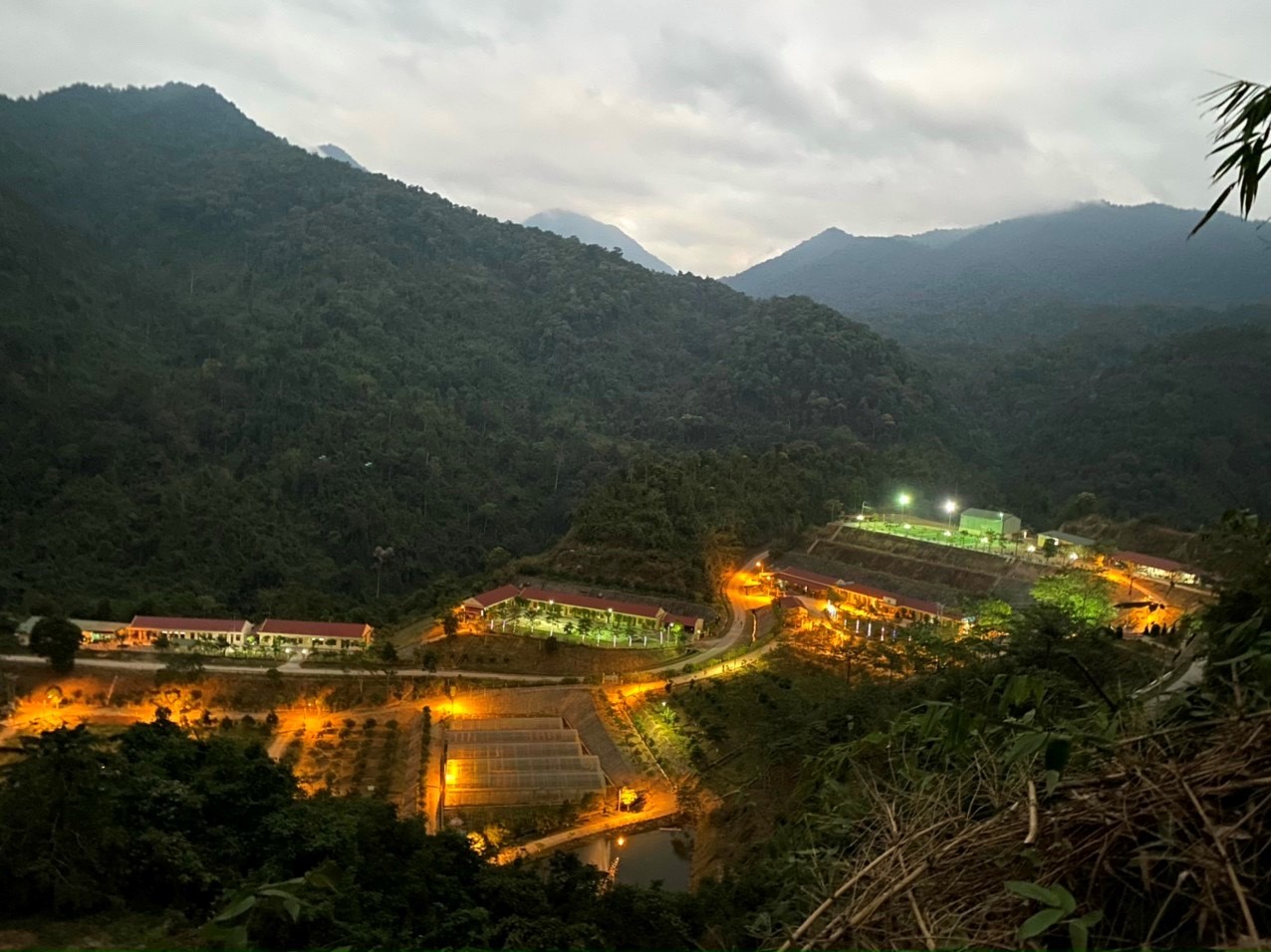
Hua Na Hydropower Plant (Photo: DNCC)
A key difference in this response that contributed to the safe operation of the Hua Na Hydropower Plant was the application of a real-time reservoir operation support system. The plant was provided with rainfall forecasts, reservoir inflow discharges and flood regulation scenarios with reliable accuracy throughout the operation. During Storm No. 3, forecast bulletins indicated a peak inflow to the reservoir exceeding 6,000 m³/s (a historic flood peak never previously recorded). This information enabled Hua Na Hydropower to proactively plan early spillway releases, ensuring the safety of the dam and downstream areas.
By Storm No. 5, the forecasting model continued to be effective, providing detailed scenarios for rainfall and discharge, recommending lowering the water level to a safe threshold, opening up storage capacity for flood absorption, ensuring compliance with management and operational regulations, and safeguarding the critical civilian bridge located 3 km from the hydropower dam. In addition, thanks to accurate forecasts, the plant reduced its flood discharge, helping the Cua Dat reservoir protect the Bai Thuong Hydropower Plant downstream, which faced the risk of water levels rising to an incident threshold.
Real-time operational technology – an inevitable requirement for hydropower
This reality shows that operating hydropower based on experience and manual monitoring is no longer adequate for responding to today's natural disasters. Storms are increasingly erratic, intense and rapid, demanding a new approach: a real-time operational support technology. With this system, the operators of the Hua Na Hydropower Plant, with their many years of experience, were able to regulate floods effectively using reliable forecast data, reduce risks in decision-making, and improve multi-reservoir coordination, avoiding isolated flood releases that put pressure on downstream hydropower plants and areas. This is the technological "shield" that enables Hua Na Hydropower not only to protect its own works but also to ensure the safety of infrastructure and people's livelihoods.

Reservoir Operation Support Center
In recent years, the Government has repeatedly emphasized the requirement that multi-reservoir hydropower plants deploy real-time reservoir monitoring and operation systems, as clearly stipulated in Article 38 of the Law on Water Resources and Decree 53/2024/ND-CP. This shows that real-time operational support systems are no longer a "nice to have" tool, but have become an inevitable solution for hydropower to proactively respond to extreme weather.
The safe operation story of the Hua Na Hydropower Plant during Storm No. 3 and Storm No. 5 demonstrates that, when supported by modern technology, hydropower can be more proactive in the face of unpredictable disaster scenarios. Project safety is maintained, downstream areas are protected, and people's daily lives are not disrupted. It also proves that technology, when applied correctly, becomes a reliable companion for the hydropower sector amid increasingly severe climate change.
Right after Storm No. 5 had just passed, the Hua Na Hydropower Plant immediately began preparing response plans for the new storm forming over the East Sea. The reservoirs are still full of flood water, but Hua Na has already made plans to ensure safety.


